


On the threshold of the opening of the new theatrical season, the Primorsky Stage of the Mariinsky Theatre and the National Centre “Russia” in the Primorsky Territory held a joint educational campaign which was dedicated to the 125th anniversary of the first performance of Nikolai Rimsky-Korsakov’s opera The Tale of Tsar Saltan. Within several days, the public could look at the familiar piece from different sides: through literature, the Russian language, music and theatrical art.
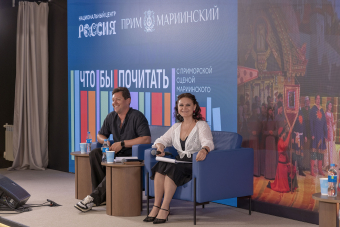
The first part of the joint program was an appearance of soloists of the Opera Company at the National Centre “Russia” in the Primorsky Territory. As part of the “What Should Be Read” project, the soloists of the Opera Company Alena Diyanova and Yevgeny Mizin unusually acted as reciters. They recited fragments from Pushkin’s fairytale and the opera libretto, and the art critic of the Primorsky Stage, Oleg Maryash, told the audience how the literary source had turned into a musical performance. The guests could hear the familiar texts in the artists’ reading to compare them with the respective opera fragments.
The program continued with a meeting at the Primorsky Stage. On July 26, 2026, before the performance of The Tale of Tsar Saltan, the guide of the National Centre “Russia” in the Primorsky Territory, Anna Nomakonova, gave a lecture on language features of Russian fairytales. The talk combined literature with history and features of Pushkin’s language with Rimsky-Korsakov’s musical heritage. In particular, the public learned about the composer’s sea voyages and a possible link between the Island of Buyan and Russky Island not far from Vladivostok.
The separate part of the program was a creative master class on Russian folklore. Children and adults could paint wooden figures and create their own souvenirs in the Russian folk style. Thus, the acquaintance with the performance went beyond the auditorium and continued in a creative format.
The Tale of Tsar Saltan has become a unifying thread in the two meetings which allowed the public to look at the opera as a literary text, a musical composition and a part of the national cultural tradition.