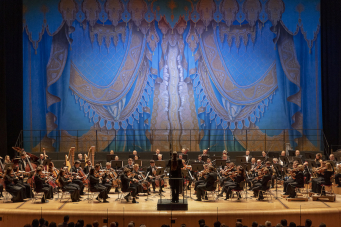



The onset of spring will be marked by an encounter of two musical geniuses. On March 1, 2026, the concert “Le Sacre du printemps. Mozart. Stravinsky” will be held at the Great Hall of the Primorsky Stage of the Mariinsky Theatre. The programme will unite two apices of the musical art: the perfect harmony of Viennese classicism and the elemental power of Russian avant-garde. Pavel Smelkov will take the conductor’s console.
Part I of the evening will be dedicated solely to Wolfgang Amadeus Mozart. The programme will open with the Overture from the opera Don Giovanni, a composition where the images of the title character and the Stone Guest are captured.
Opera soloist Alina Mikhailik (soprano) will perform several rarely heard concert arias by Mozart. Unlike operatic arias, these works reveal absolute vocal mastery and the depth of lyrical expression rather than the dramatic power of the image.
The central theme of Part I will be the song “Sehnsucht nach dem Frühling” and the Piano Concerto No. 27, which was Mozart’s last saying in this genre. Written in the year of the composer’s death, this concerto is imbued with bittersweet yearning and peace; in the finale, the theme of “Sehnsucht nach dem Frühling” is brought forward as the principal musical idea. Thus, the concept of impatient anticipation of the nature’s transformation, the joy of melting snow, and the return of birds, is affirmed through vocal and instrumental means. The concerto will be performed by prize-winner at international competitions, pianist Andrei Ivanov, accompanied by the Mariinsky Orchestra of the Primorsky Stage.
Part II of the evening will feature a revel of orchestral colors in the music from Igor Stravinsky’s ballet Le Sacre du printemps (The Rite of Spring). The masterpiece premiered in Paris in 1913, sparkling one of the most notorious scandals in the theatrical history, so shocked were the audiences by the “barbaric” music and the unusually crude choreography. Today, Le Sacre du printemps is perceived as a manifesto of new art, a musical portrait of the pagan Rus, where a fertility ritual culminates in a great sacrifice.
The powerful orchestra performance, frenetic rhythms, and the dynamic formulaic motifs symbolize not only the awakening of nature, but also the evocation of music itself.